01 · Key decisions
Three decisions after taking over
Building on the first requirements
- Problem
- The first project manager left after writing v1 of the requirements.
- Decision
- Keep v1 as the baseline, close its open decisions with the client, and own delivery to launch.
- Trade-off
- Some inherited decisions stayed as they were.
- Said no to
- Re-scoping from scratch, which would have stalled the team.
- Worth it because
- The platform launched about two months later.
Metrics before launch
- Problem
- Without agreed targets, “launched” would be the only measure.
- Decision
- Set success metrics and launch KPIs with the client before launch.
- Trade-off
- Time spent on alignment before build.
- Said no to
- Measuring only after launch.
- Worth it because
- Results are tracked against targets agreed upfront.
Compliance one step at a time
- Problem
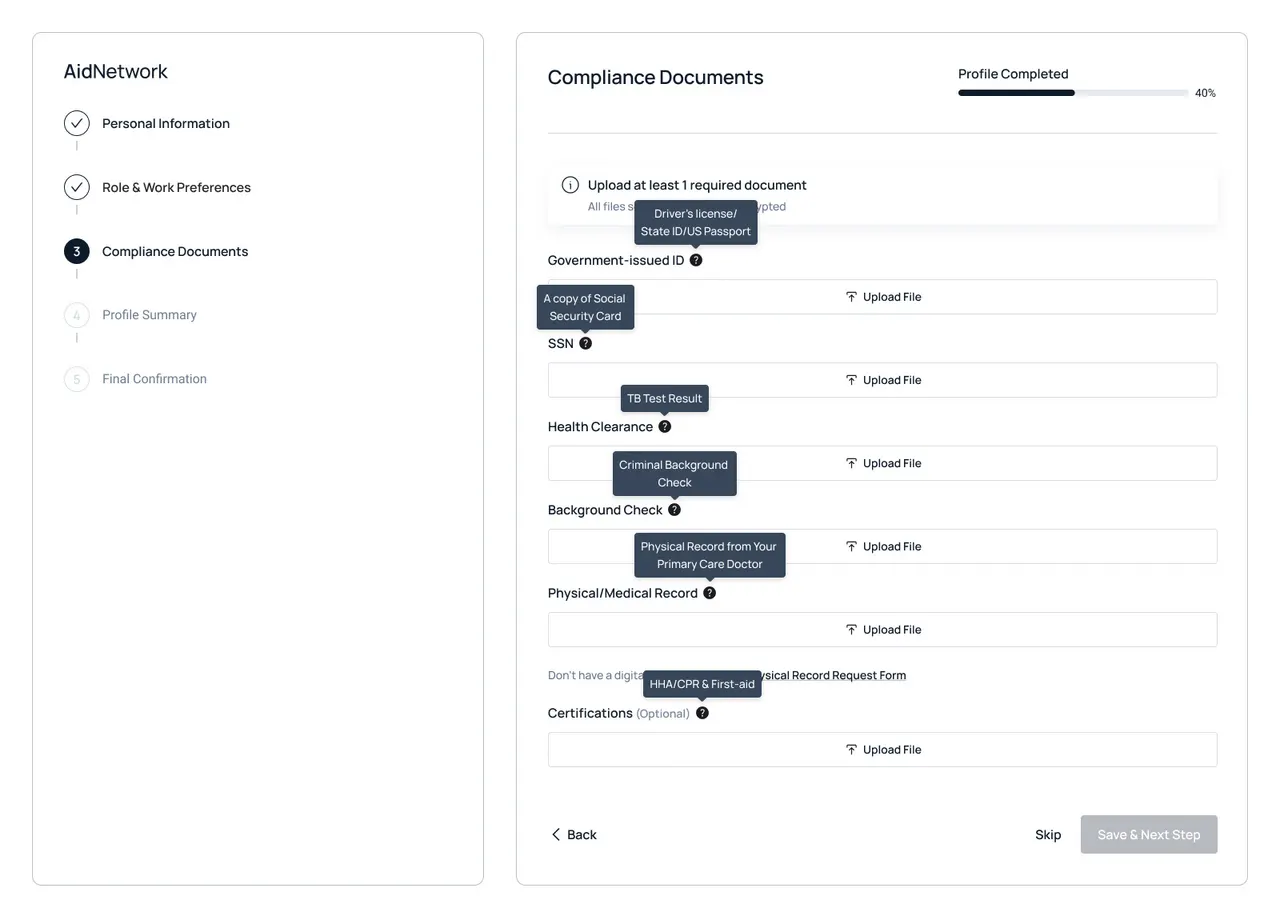
- Candidates must upload government ID, SSN, health clearance, background check and medical records: a long list of requirements that drives drop-off.
- Decision
- Split onboarding into five steps (personal information, role and work preferences, compliance documents, profile summary, confirmation), with a profile-completion bar, a short explanation for every document, and the option to skip and return.
- Trade-off
- More steps.
- Said no to
- One long compliance form.
- Worth it because
- Candidates always know what is needed and why.
02 · Execution
Four surfaces, with the candidate journey tested first
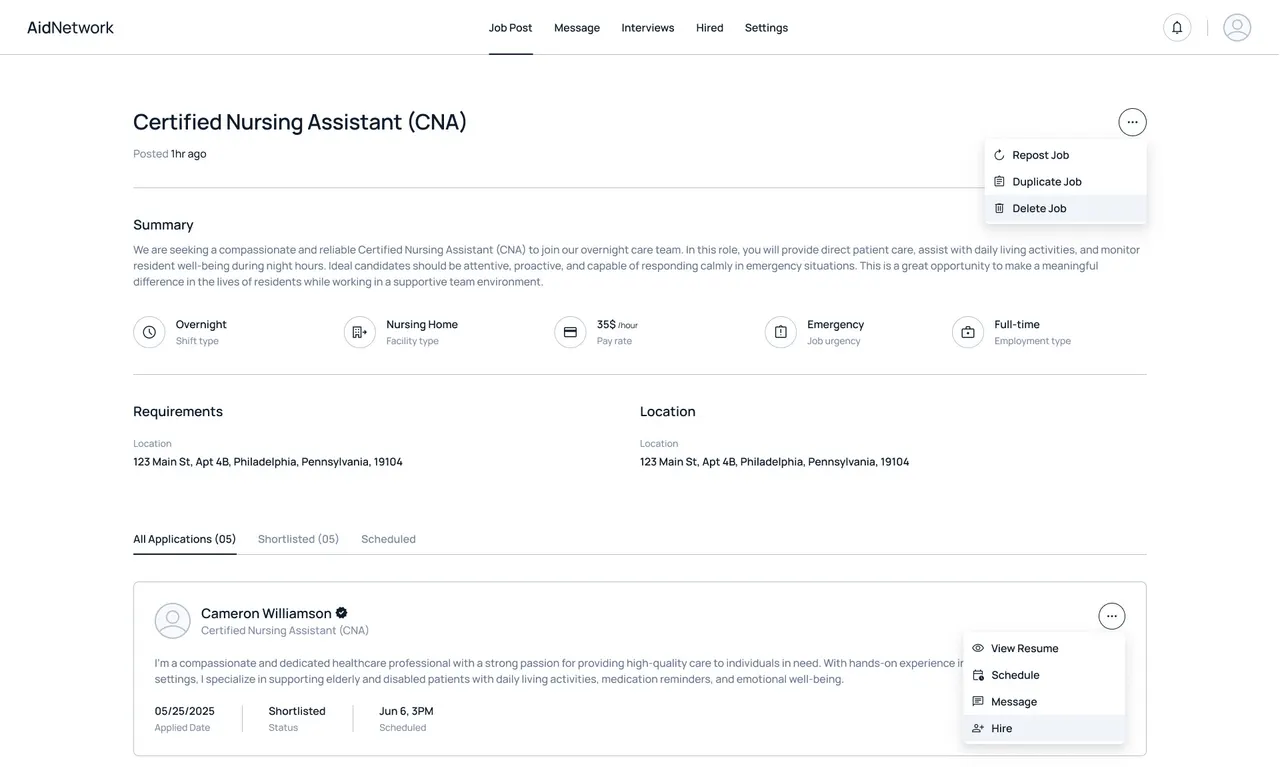
Four surfaces: the candidate web app, the employer web app, the admin portal and the candidate mobile app. I validated the candidate journey with users before build.
03 · Outcome
Launched about two months after I took over
- Launched about two months after I took over, across four surfaces.
- Live with 6,000+ healthcare professionals.
- A 42.67% placement rate per application, as reported by the client.
- Results tracked against success metrics and launch KPIs agreed before launch; improvements in progress.
Professional count and placement rate as reported by the client.
04 · What I'd do differently
Run a handover audit on day one
Taking over mid-project, I'd start with a structured handover audit (every inherited decision, open question and assumption in the requirements) before changing anything, so nothing important is lost in the switch.