One product instead of three tools, now live with 900+ companies.
KpiClock is an all-in-one team management SaaS for “everything after you’re hired”: time tracking, HR and e-signature in place of Hubstaff, BambooHR and DocuSign.
Teams ran time tracking, HR and e-signature on three tools (Hubstaff, BambooHR and DocuSign), with three bills and three logins. KpiClock, for a US client, had to replace all three with a four-person team.
My role
I was the Product Manager and Lead Product Designer on KpiClock. I owned the product: scope, sequencing, information architecture, user flows, UX/UI, pricing and positioning. I sequenced it as V1 (time tracking) and V2 (HR and e-signature).
Result
KpiClock is live with 900+ companies and 25,000+ users. V1 reached beta in about three months, and V2 added HR and e-signature after it.
900+
Companies
25,000+
Users
3
Tools replaced: time tracking, HR and e-signature
6
Integrations: ClickUp, Jira, Trello, Asana, Linear and Monday.com
01 · Users & goals
One product for running a team
KpiClock, built for a US client, covers what a team needs once people are on board: time tracking, attendance, leave, rosters, documents and e-signature, in place of Hubstaff, BambooHR and DocuSign. It replaces three tools, three bills and three logins with one.
I owned the product: scope, sequencing, information architecture, user flows, UX/UI, pricing and positioning.
Who it's for
Admins
Owners and admins: the Admin dashboard, and leave approvals.
Team leads
The Team dashboard, and leave approvals for their team.
Employees
Track their time on the My dashboard, check in and out, and request leave.
HR
Attendance, rosters, documents and e-signature. HR permissions arrived with the HR modules, and HR approves rosters.
What it replaces
Hubstaff
Time tracking (replaced in V1).
BambooHR
HR (replaced in V2).
DocuSign
E-signature (replaced in V2).
02 · Key decisions
Replacing three tools one at a time
Ship time tracking completely first, then HR and e-sign
Problem
Replacing three tools at once with a four-person team.
Decision
Ship the time tracking side completely first (V1), then HR and e-signature (V2).
Trade-off
The all-in-one promise was incomplete at launch.
Said no to
Launching every module half-built.
Worth it because
Time tracking is the tool teams open every hour. Daily use earned the right to add HR.
Monitoring, with privacy built in
Problem
Managers want proof of work, but teams on NDA client work can’t expose their screens.
Decision
Screenshots with a blur mode.
Trade-off
Less visual detail for managers.
Said no to
Always-on raw screenshots.
Worth it because
Teams under NDA could adopt it at all.
Approvals you can see, conflicts caught at creation
Problem
Leave and rosters need several approvers, and roster conflicts surfaced late.
Decision
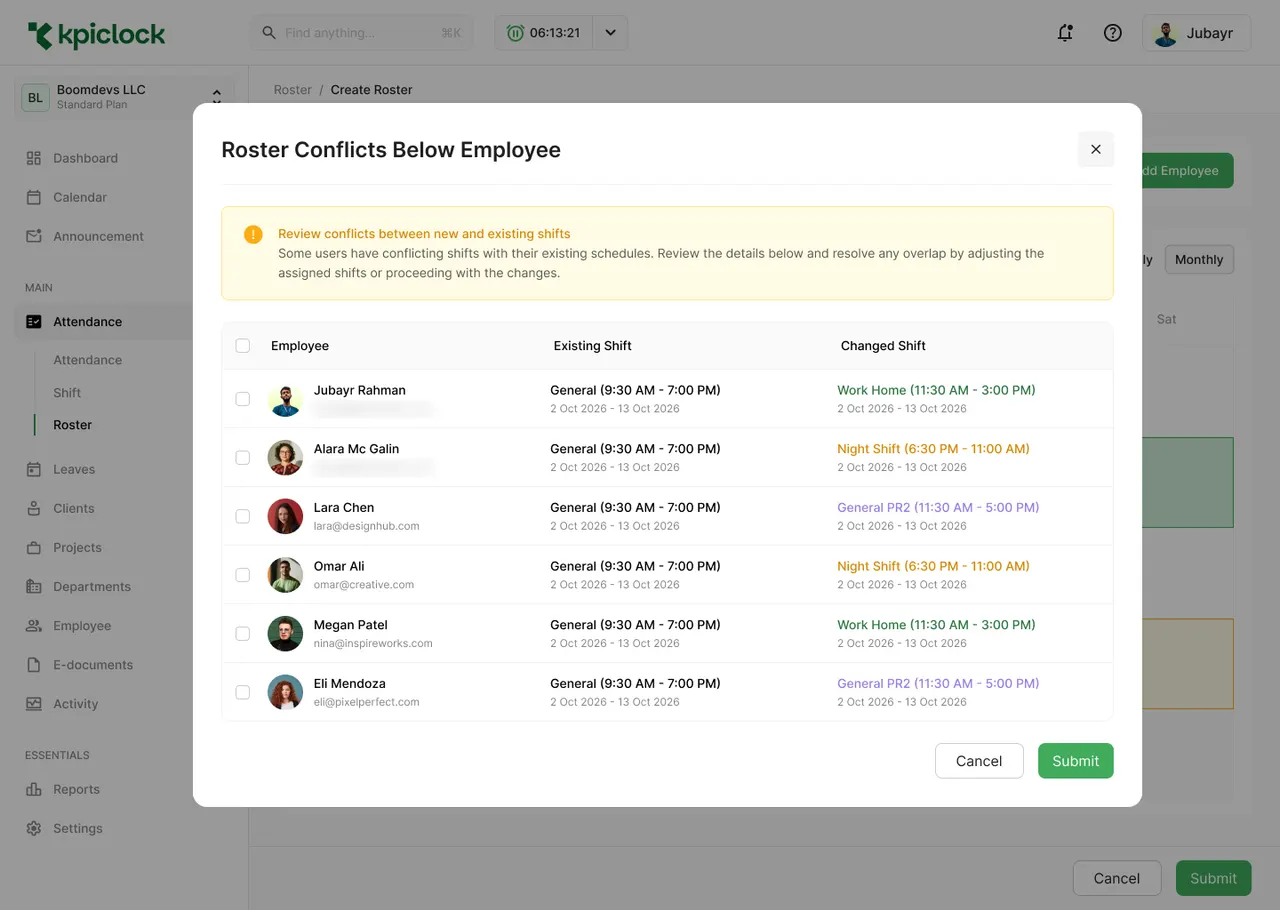
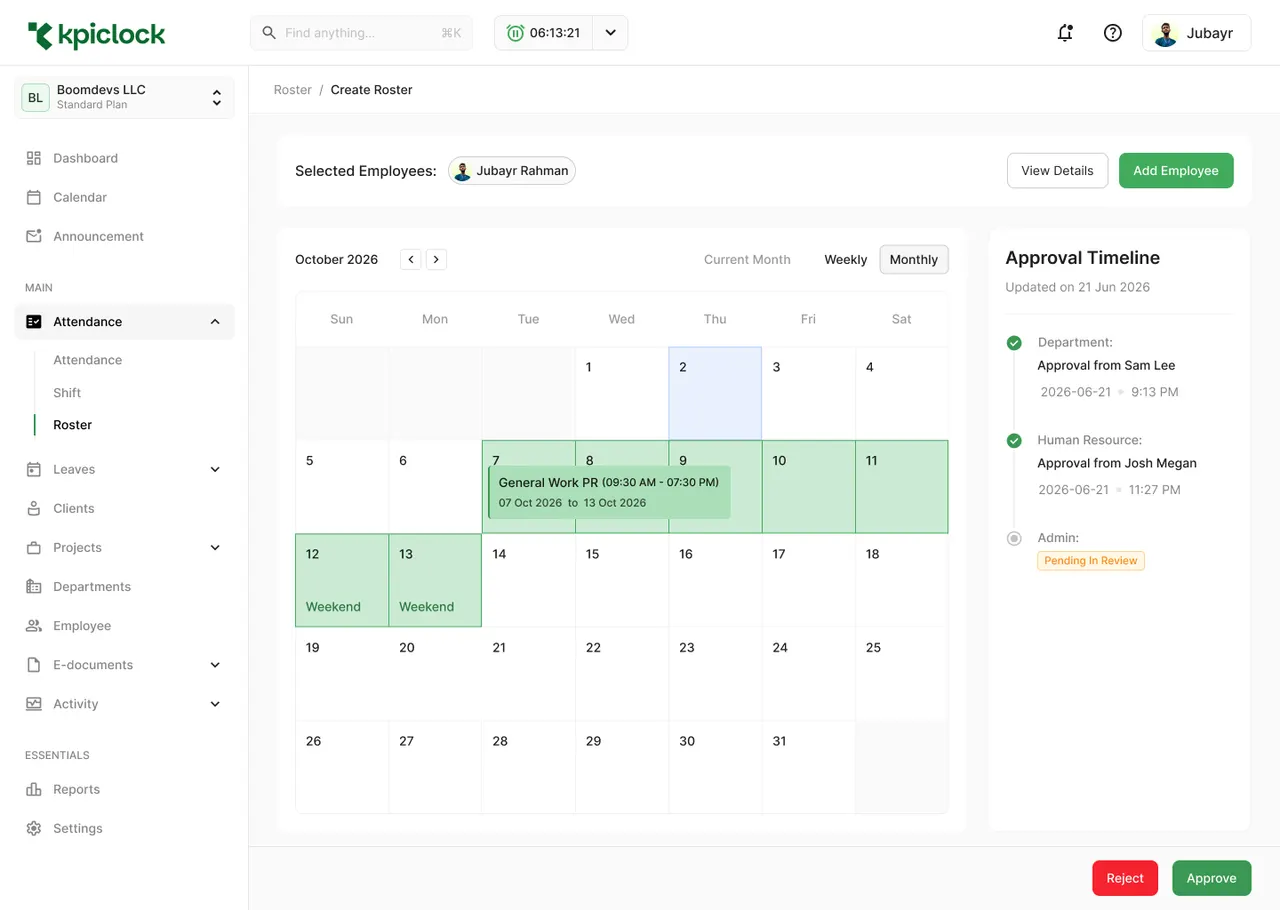
A multi-tier approval engine with the state visible at every step (team lead and admin for leave, HR for rosters), and roster conflict detection at the moment a roster is created, before it’s submitted.
Trade-off
More rules to configure upfront.
Said no to
Single-step approvals, and catching conflicts after submission.
Worth it because
No request disappears into a queue, and bad rosters never reach approval.
Conflicts flagged when the roster is created
Positioning and per-user pricing
Problem
Buyers compare KpiClock against three separate subscriptions.
Decision
The “everything after you’re hired” positioning, simple per-user pricing in two tiers, and a cost comparison tool on the marketing site.
Trade-off
It invites price comparison.
Said no to
Per-module pricing.
Worth it because
The value of consolidation is visible in one number.
03 · Execution
V1 in about three months, then V2
We started on 14 July 2025 with a team of four: me, one product designer, one backend engineer and one frontend engineer. V1 reached beta in about three months, and V2 shipped after that.
What was in V1 and what came later
Time tracking shipped complete in V1; HR and e-signature waited for V2. That was the rule from the first decision: finish the tool teams open every hour before adding the rest.
V1: in place of Hubstaff
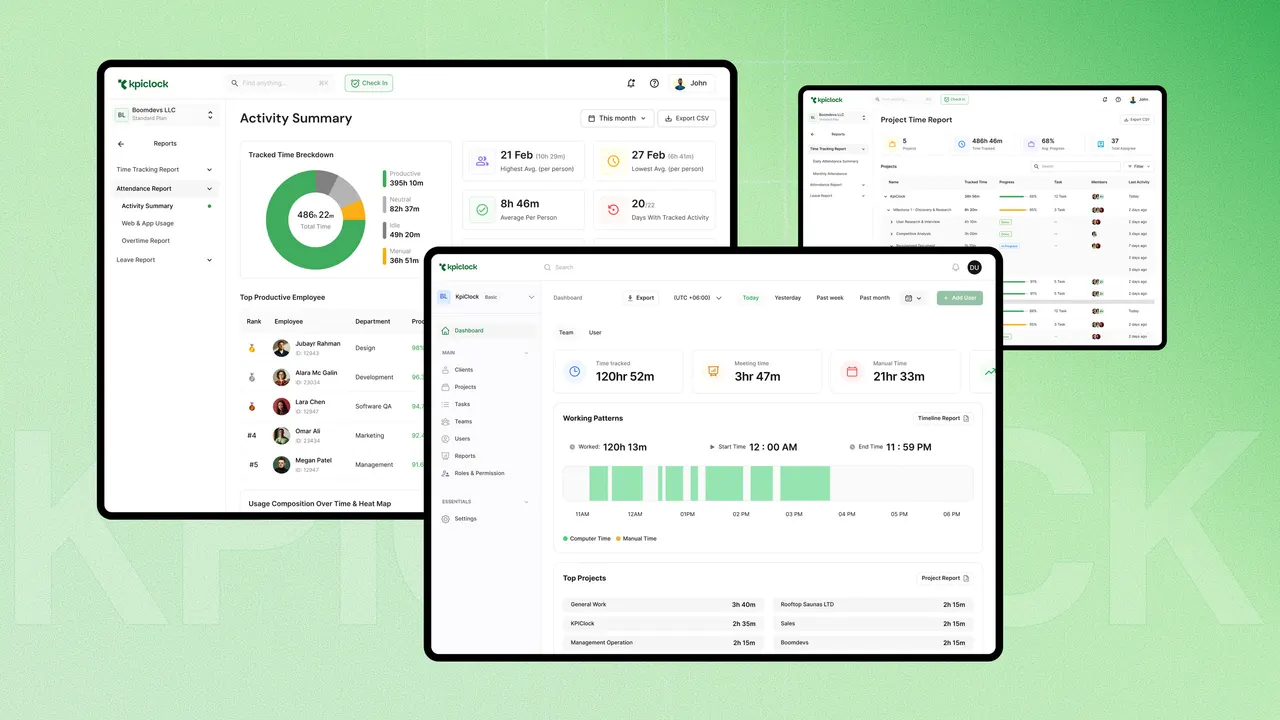
Manual and automatic time tracking, with offline sync and billable and non-billable hours.
Productivity monitoring with screenshots, plus a blur mode for NDA work.
Web and app usage, with productivity ratings.
Native desktop apps for Windows, macOS and Linux.
6 integrations: ClickUp, Jira, Trello, Asana, Linear and Monday.com.
Clients, projects and tasks, and teams.
Three role dashboards: My, Team and Admin.
Reports you can export to CSV, Excel and PDF.
Per-seat plans and billing.
V2: in place of BambooHR and DocuSign
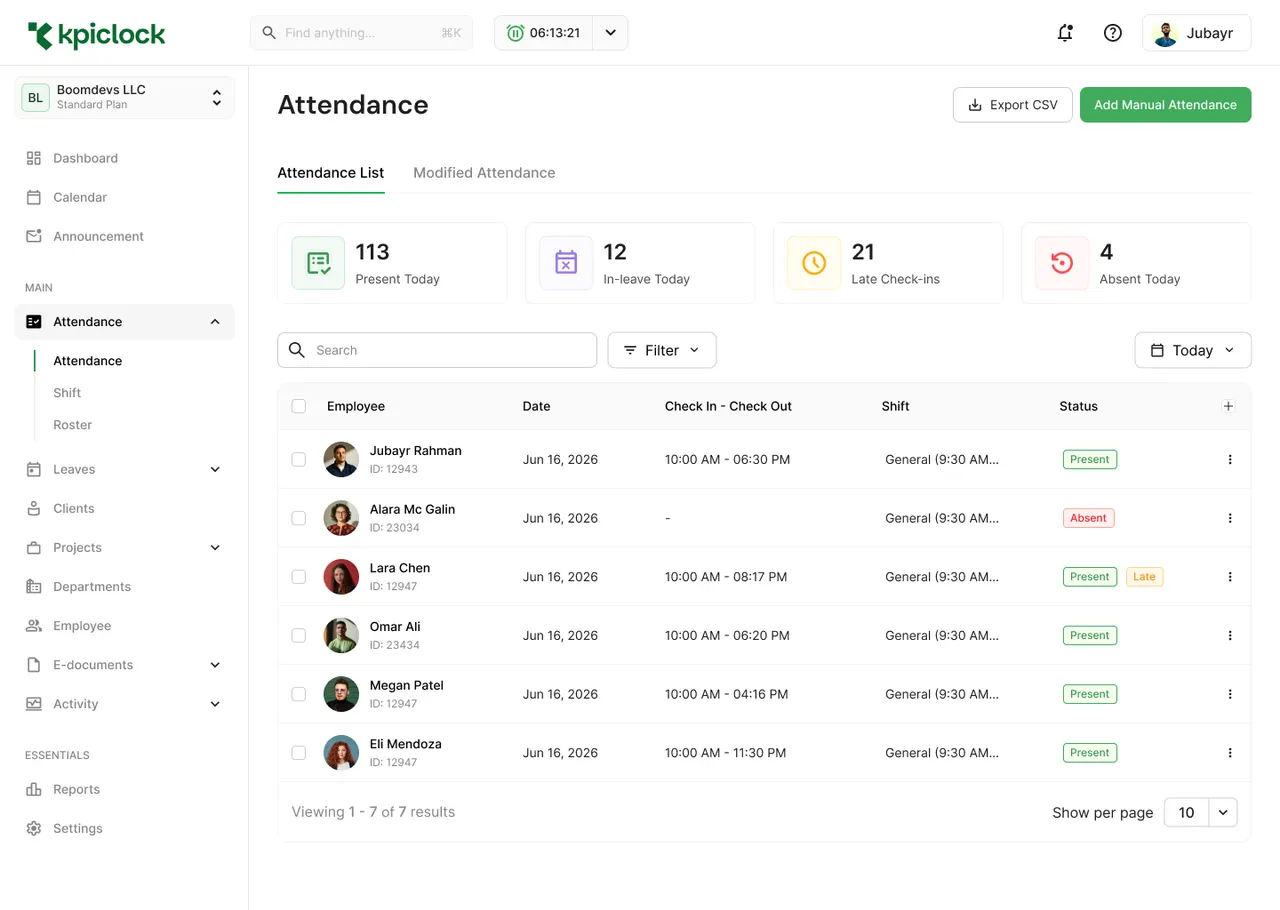
Attendance: check-in and check-out, late and absent detection, a monthly calendar, and manual entries with a reason.
Leave: policies, types, balances, and request and approval.
Shifts, rosters and public holidays.
Organogram and departments.
An employee document repository with templates.
ESIGN-compliant e-signature with multi-party signing, status tracking and reminders.
Audit logs for attendance edits, leave approvals and signing.
V1 · beta in about 3 monthsTime tracking, in place of Hubstaff
Manual and automatic time tracking, offline sync
Billable and non-billable hours
Screenshots with a blur mode
Web and app usage, productivity ratings
Desktop apps for Windows, macOS and Linux
6 integrations
Clients, projects, tasks and teams
My, Team and Admin dashboards
Reports to CSV, Excel and PDF
Per-seat plans and billing
V2 · after V1HR and e-signature, in place of BambooHR and DocuSign
Attendance
Leave
Shifts, rosters and public holidays
Organogram and departments
Document repository with templates
ESIGN-compliant e-signature
Audit logs
Roadmap · V1 time tracking → V2 HR and e-signature
Marketing site and pricing
The 11-page marketing site was built in Framer and delivered in 3 weeks, with an interactive cost comparison tool. Its pricing comparison for a 50-user team shows a 70% saving. Pricing is per user, in two tiers.
V2 · attendanceRoster approval · every approver's status visible
04 · Outcomes
Live with 900+ companies
Live with 900+ companies and 25,000+ users.
During beta, the client's own company and two partner companies ran their daily operations on it.
V1 reached beta in about three months, and V2 followed: Hubstaff was replaced first, then BambooHR and DocuSign.
Native desktop apps on 3 platforms (Windows, macOS and Linux) and 6 integrations.
After launch: what we changed
Feedback
The client saw people start the time tracker but forget to check in, so attendance showed them absent while they were working.
Change
Starting the time tracker now marks attendance automatically.
Why it mattered
Attendance now follows actual work, with a single record of time.
05 · What I'd do differently
Build one scheduling foundation from day one
I’d design calendar, workflow and roster as one shared scheduling foundation from day one. Shifts, leave, holidays and rosters all depend on the same time rules, and building them as separate modules meant reconciling them later.