If you're building a product, you may be deciding who to bring in first: a product manager or a product designer. From the outside the two roles look alike. Both talk to users, both draw flows, both care about what ships.
I've worked as both, often on the same project. On KpiClock my role was Product Manager and Lead Product Designer; on Find Your Calm, Product Manager and Product Designer; on AidNetwork, Product Manager only. Here's how I'd explain the difference, and when one person can do both.
What does a product manager do?
A product manager decides what to build and why. That covers the problem, the scope, the order things ship in, the pricing, the launch, and how success is measured.
On KpiClock, a team management product now live with 900+ companies, I owned the product: scope, sequencing, information architecture, user flows, UX/UI, pricing and positioning. The product manager side of that was the sequencing call (time tracking first, HR and e-signature second) and the per-user pricing in two tiers.
On AidNetwork, a healthcare staffing platform, my role was Product Manager alone. I took over the requirements mid-project, set success metrics and launch targets with the client, and led two designers and two developers to launch all four parts of the product, about two months after I took over.
What does a product designer do?
A product designer decides how the product works and looks: the flows, the screens, the interactions, and the design system that keeps it consistent.
On Find Your Calm, a booking platform for wellness operators, I was the only designer on the team. I designed the admin panel, the customer portal and the operator-branded mobile app. The old booking system took 9 steps; I designed a 4-step flow, the client approved it, and booking completion rose 31% against the old system after the new design replaced it. I wrote about that in How we cut a booking flow from 9 steps to 4.
Product manager vs product designer, side by side
| Product manager | Product designer | Both in one person | |
|---|---|---|---|
| Main question | What should we build, and why? | How should it work and look? | Both, answered together |
| Owns | Scope, order, pricing, launch, success metrics | Flows, screens, interactions, design system | The decision and the design behind it |
| Typical output | Goals, requirements, roadmap, launch plan | Wireframes, prototypes, UI, components | Requirements and designs that agree with each other |
| Works most with | Founders, clients, engineering, sales | Users, engineering | All of them |
| An example from my work | AidNetwork: metrics agreed before launch; launched about two months after I took over | Find Your Calm: the 4-step booking flow | KpiClock: sequencing and pricing, plus the information architecture and UX |
Where do the two roles overlap?
Users, flows and scope. A product manager can't set scope without knowing how people use the product, and a designer can't design flows without knowing what's in scope. On a well-run team they hand work back and forth on exactly those three things.
When one person holds both, that hand-off disappears. On Find Your Calm, the decision to move memberships, packs and gift cards into the booking journey was a business decision (recurring revenue, and knowing who the customer is on every booking) and a design decision (where in the flow the offer sits) at the same time. Its cost, fewer first-time visitors finishing a booking, was visible from both sides at once.
When can one person do both, and when not?
It works well early. On a small team, with a product that's still being decided, one person who can decide and design keeps the two in step. Varsee, an AI live-shopping product, started from an idea with no documentation; as Co-founder and Head of Design I owned the product decisions and designed all five parts of the product, and the full prototype was ready in six weeks.
It changes as the product grows. The design work grows faster than one person can carry. On KpiClock I owned the UX for the whole product and guided one product designer's work. On LeanDeck I led two product designers. At SmartPeople, an HR and payroll platform, I led a team of six alongside 40+ engineers. In each case I still made the product decisions and led the design, and the design work was shared with the team.
My view on when it doesn't work: when the product needs deep specialist work on one side, or when the volume of decisions alone is a full-time job. Then two people, working closely, will do better than one.
How do I split the work on a project?
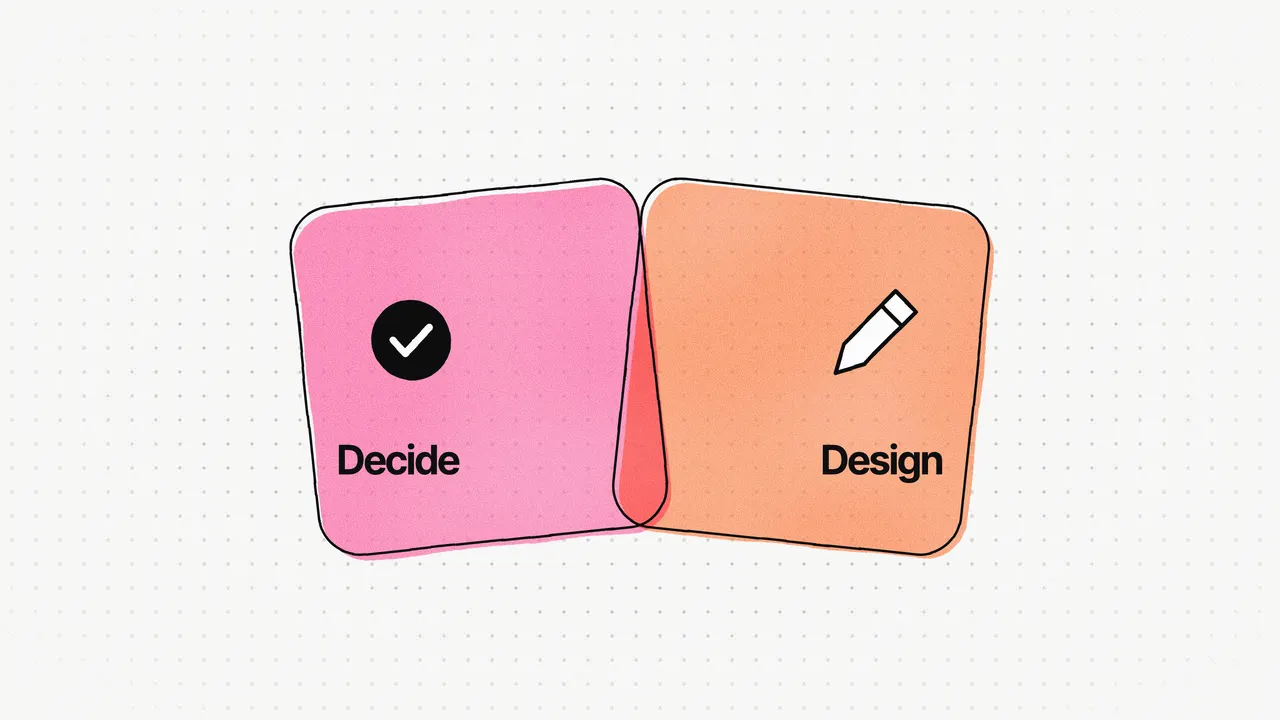
The short version is the line I use about my work: I decide what to build and why, and I design it.
In practice, decisions come first. I turn the brief into goals, work out the users and what they do today, and set the scope and the rules. That's the discovery work I describe in Product discovery for startups. Then I design against those decisions: information architecture, flows, screens. While the product is built, the two keep feeding each other. A design problem often turns out to be a scope question, and a scope question often gets settled faster with a quick prototype.
If you're a founder choosing who to bring in, my suggestion is to start from where your uncertainty is. If you don't know what to build or for whom, you need product decisions first. If you know exactly what to build, you need design. If you don't know either, someone who can do both will cover the most ground in the first months.
Frequently asked questions
What is the difference between a product manager and a product designer?
A product manager owns what gets built and why, including scope, priorities, pricing and success metrics. A product designer owns how it works and looks, including flows, screens and the design system. They overlap on users, flows and scope.
Do startups need a product manager?
Someone has to decide what to build, in what order, and how success is measured. In a small team that's often a founder; once the founder can't keep up with those decisions, a product manager takes them on. On AidNetwork, setting success metrics and launch targets with the client before launch was part of my job as Product Manager.
Can one person be both product manager and product designer?
Yes, and on small teams it often works well. On Find Your Calm I was the Product Manager and the only designer on the team, and I both designed the pricing model and redesigned the booking flow from 9 steps to 4. As products grow, the same person usually leads other designers instead of designing everything alone.
Should I hire a product manager or a product designer first?
It depends on where the uncertainty is. If you don't yet know what to build or for whom, start with product decisions; if you know exactly what to build and need it to work well, start with design. If both are open, someone who can do both covers more ground early.