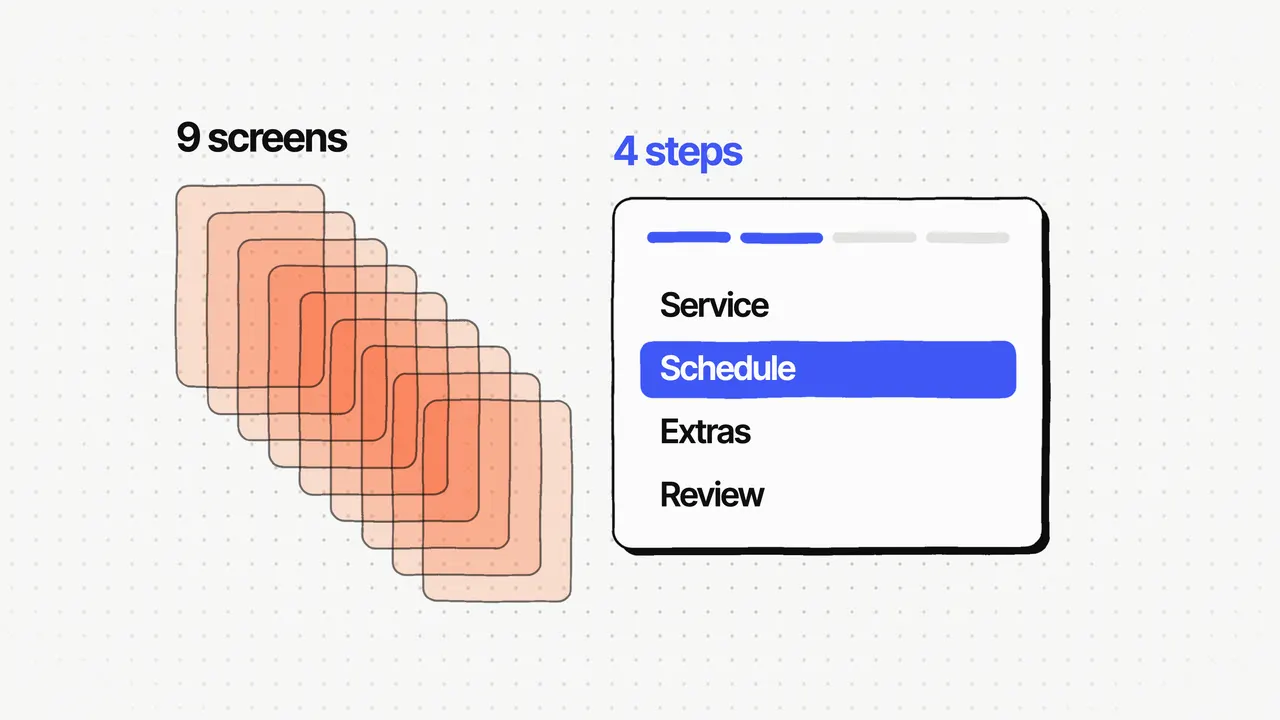
Find Your Calm's booking flow used to take 9 steps. I redesigned it into 4, and after the new design replaced the old system, booking completion rose 31%. The four steps are Service, Schedule, Extras and Review.
This post covers how we got there: what the data showed, what I removed, what I grouped, and what the change cost.
Where customers were dropping out
Find Your Calm is booking software for wellness operators. Rooftop Saunas was the first: private sauna cabins across more than one London location, with every slot priced separately and every location on its own schedule. Their old system was only a booking tool, and it wasn't designed around how customers actually book.
I added Microsoft Clarity and Mixpanel from the start of the project. Mixpanel tracked bookings, memberships, packs, gift cards and user behaviour, on the old system first and on the new platform from launch. Clarity's heatmaps and session recordings showed where customers dropped out. The biggest drop was in the booking flow, so we fixed that first.
The problem was simple to describe. The old system took 9 steps to make a booking, and it asked for too much information along the way. Every extra screen was another place to drop out.
The old modal next to the new one
The old flow gave small decisions their own screens. Choosing a location was a step of its own. There was a separate form, a guide and a room screen. Nothing told the customer how far they were from the end.
The new flow has four steps, and every step shows where you are.
Every extra screen was another place to drop out.
What I removed and what I grouped
I removed the separate form, guide and room screens. Then I grouped related actions, so each step holds two or three of them instead of one action per screen:
- Service: choose the session and the number of people.
- Schedule: pick a date and time. Peak times are marked, and if nothing fits, the customer can ask to hear when a slot opens up.
- Extras: optional add-ons, with a running total.
- Review: sign in or create an account, add a coupon, and pay.
Two smaller details carry the same idea. The progress bar answers the question every customer has halfway through a form: how much is left? And the booking summary fills in as you go, so nobody has to go back to check what they picked.
With every slot priced separately and every location on its own schedule, there were a lot of booking scenarios to cover. So we mapped every one of them before any screen was designed, with wireframes in Miro and Figma.
I proposed the 4-step flow and got the client's sign-off on the design. It was designed during the build, before launch. Every booking path was tested before the switch-over, and all the data moved across from the old system, so bookings kept flowing while Rooftop Saunas changed systems.
What it cost
The trade-off was real. Wellness businesses were used to a standard step-by-step booking pattern, and this flow moved away from it. Operators had to adjust to a new way of working.
A second cost came from a different decision. We put memberships, packs and gift cards inside the booking journey itself, where they used to come after checkout. That brought recurring revenue and told us who the customer was on every booking, but fewer first-time visitors finished a booking. Because the tracking was in place from the start, we could see that drop and decide where to work first.
The result
After the new design replaced the old system, booking completion rose 31%. That's a relative change: the underlying data is confidential, so I only show the size of the move. Find Your Calm has been live since August 2025, it now runs 17 UK operators, and a new operator goes live in under a week.
After launch, I kept improving the booking journey end to end. I used where customers dropped out, behaviour data from Microsoft Clarity, Mixpanel and GA4, session feedback and the most common support questions.
One thing I'd do differently: agree how booking completion is measured, and over what window, with the client before the switch-over. We tracked behaviour from the start, but booking completion only became a tracked metric after launch. Agreeing it earlier would have made the before-and-after comparison cleaner.