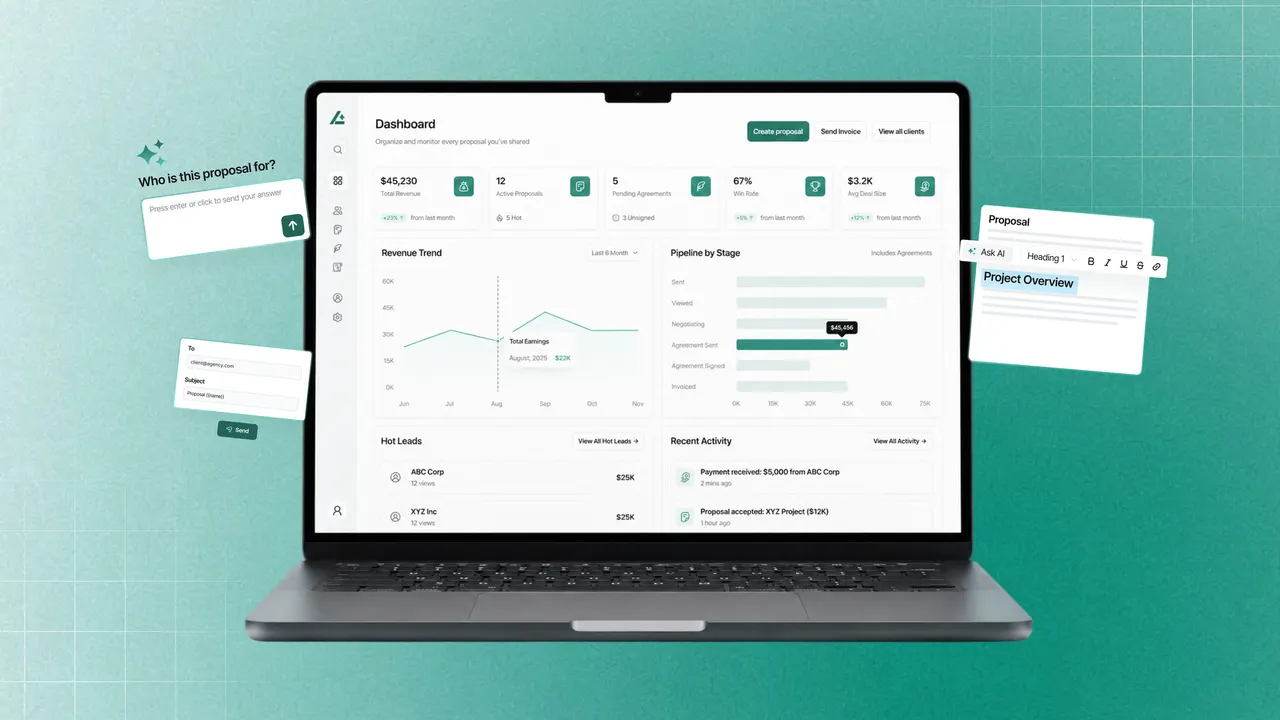
Design and dev agencies spend 6–10 hours writing each proposal by hand. LeanDeck, an AI proposal, agreement and invoicing platform for a US client, had to cut that, with AI output that is accurate and consistent in documents that are financially binding.
My role
I was the Product Manager and Lead Product Designer at Boomdevs and owned LeanDeck end to end: where AI can act, the prompts, retrieval and how AI output is evaluated, plus the pitch deck and positioning.
Result
LeanDeck's beta launched in 8 weeks with 6 agencies. It is live at leandeck.ai and used by 500+ design and development businesses; milestone billing is next.
8wk
From kickoff to beta launch
6
Agencies in the beta
500+
Design and development businesses using it today
3 → 1
Proposal, agreement and invoice in one connected workflow
01 · Users & goals
Who it's for and the problem
For design and dev agencies, a proposal takes 6–10 hours, mostly written by hand from scratch. LeanDeck, built for a US client and only for design and dev businesses, drafts it with AI and carries it through to an agreement and an invoice.
I owned the product end to end, including the billing and document journey, and decided where AI should act. I also created the pitch deck and the product positioning.
Who it's for
Agencies
Design and dev agencies that write proposals, agreements and invoices for their clients.
Agency teams
Work on the same documents in shared, multi-user workspaces.
Goals we built against
We didn't set formal metrics, but we built against three clear goals:
Time to beta
A beta with real agencies in eight weeks.
First proposal
A first proposal in about ten minutes.
Output quality
AI output usable as-is, needing only light edits before it's sent.
02 · Key decisions
Deciding where the AI acts
AI returns structured, editable sections
Problem
AI output had to be accurate and consistent every time, and a single block of generated text is hard to check and hard to fix.
Decision
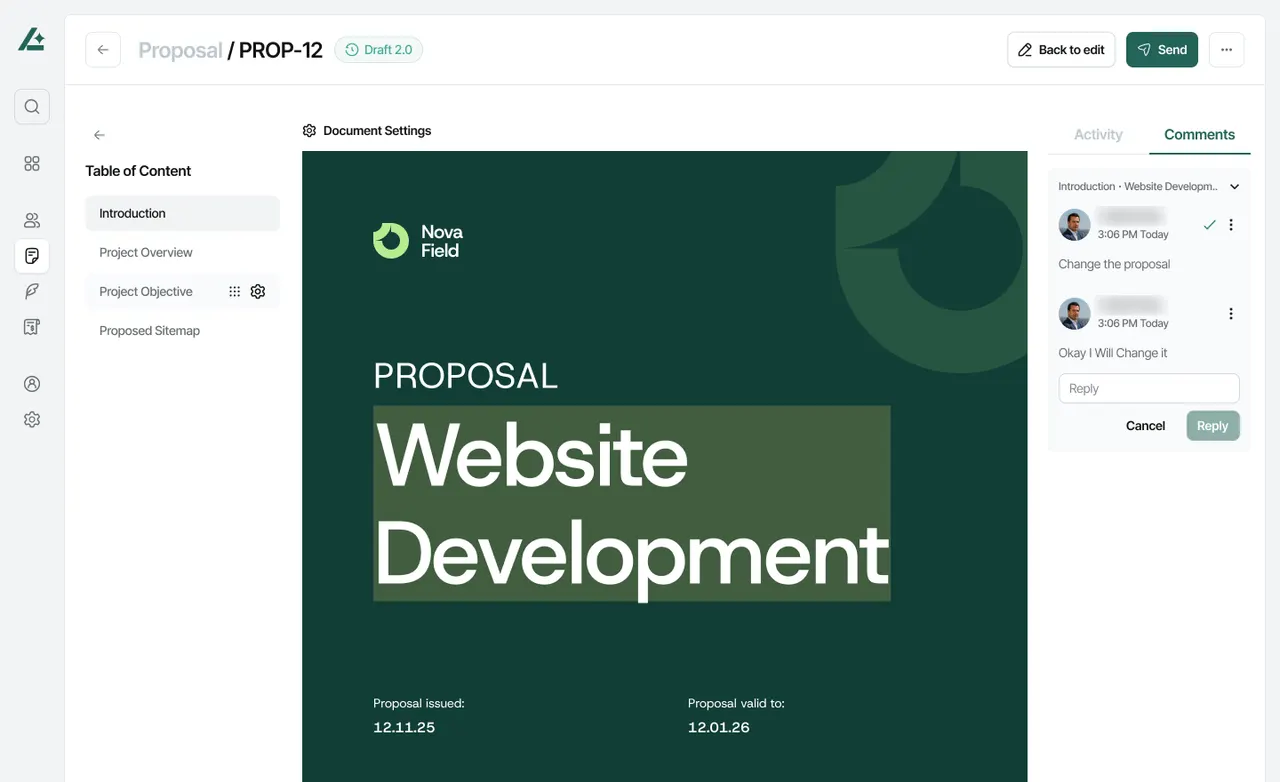
The AI returns a proposal as structured, editable sections, with a section- and sentence-level editor that has AI assistance built in.
Trade-off
More prompt and evaluation work than free-text generation, slower generation, and less freedom for the AI, which has to fit a set section structure.
Worth it because
Agencies can edit, convert and price structured sections. A block of text is something they'd have to rewrite.
AI drafts; invoicing stays deterministic
Problem
Generative AI could draft every document, but agreements and invoices are financially binding.
Decision
Scoped generative AI to proposal and agreement drafting, and deliberately kept invoicing deterministic.
Trade-off
Less automation where it would have been easiest to add, on the position that a plausible-but-wrong invoice is a worse failure than a slower one.
Said no to
AI-generated invoices.
Users can override any AI output
Problem
Financially binding documents need to be reviewable. Users can't be locked into whatever the AI produced.
Decision
Users can accept, edit or override any AI output without losing context. The product says it plainly: “The AI assists; you decide.”
Trade-off
Automation speed traded for the reviewability that financially binding documents require.
03 · Execution
From kickoff to beta in eight weeks
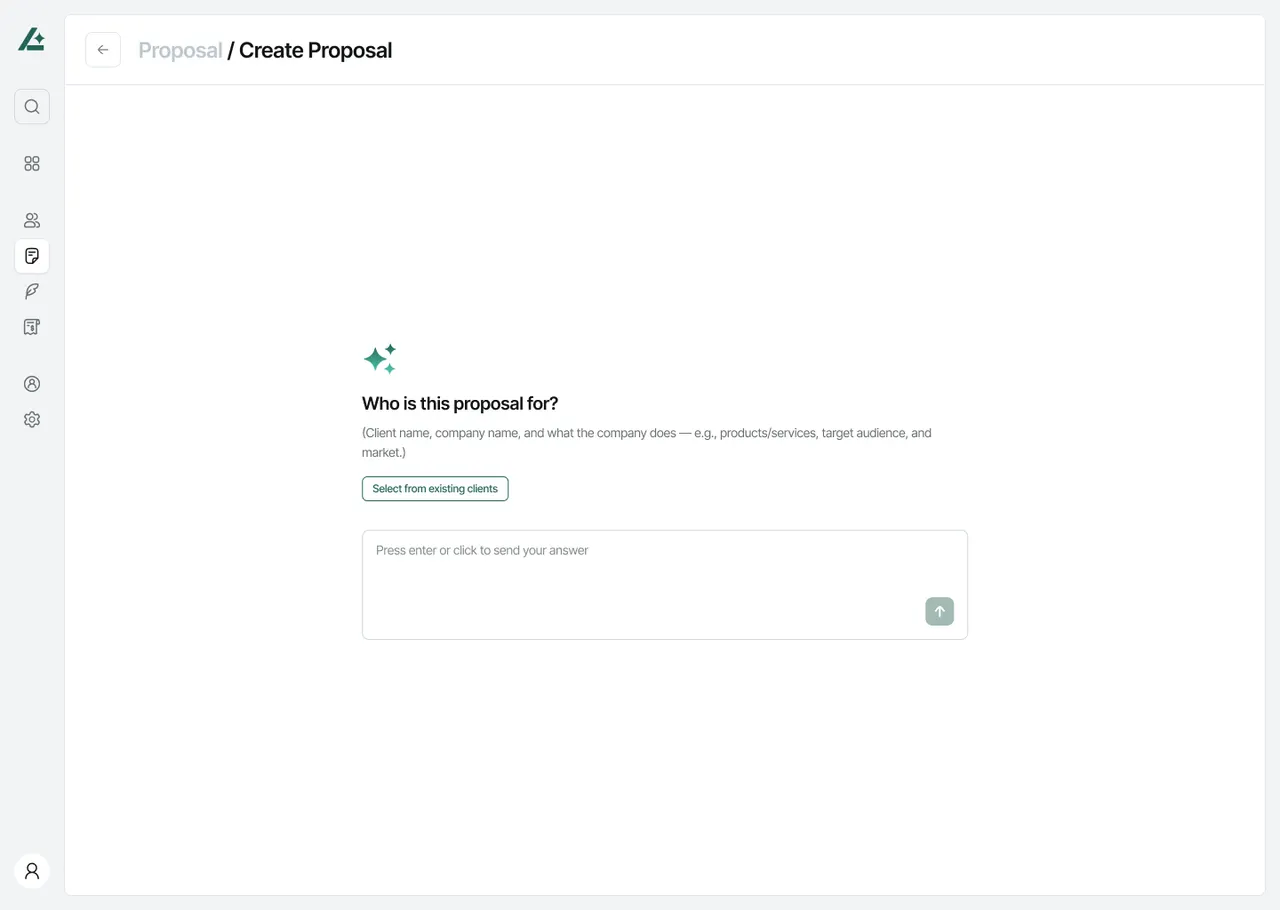
The core flow has four steps: choose a document, answer smart questions, review and refine, deliver. Two problems were harder than the rest: getting accurate, consistent AI output every time, and making the AI's cost and timeline estimates defensible. I wrote and tested the prompts, worked on retrieval, and defined the criteria for evaluating AI output. I designed the AI-assisted proposal, agreement and invoicing flows on a scalable Ant Design component library.
Smart questions · the AI asks before it draftsStructured, editable sections with team comments
What was in the beta and what came later
To hit a beta in eight weeks, I kept invoicing rule-based instead of AI-generated (the same line as the decision above), so there was one less place a plausible-but-wrong document could come from. I also moved milestone billing to Phase 2.
What shipped:
AI-generated proposals as structured, editable sections.
A section- and sentence-level editor with AI assistance.
One-click proposal to agreement, with a clause library.
AI cost and timeline estimation.
Invoicing with payment tracking.
Multi-user teams and workspaces.
Built on Django and FastAPI, GPT-5.1 and Next.js. We kicked off on 9 November 2025 and launched the beta in early January 2026 with 6 agencies. Alongside the build I created the pitch deck and the product positioning. Phase 2 (milestone billing) is in progress.
Beta launched in 8 weeks: kickoff on 9 November 2025, live in early January 2026.
The beta started with 6 agencies.
500+ design and development businesses use it today.
Live at leandeck.ai, with Phase 2 (milestone billing) in progress.
Customer count as published on leandeck.ai.
After launch: what we changed
Feedback
Agencies asked for more design options, and to paste a client conversation and get their documents from it.
Change
More proposal and agreement designs, and conversation-to-documents: paste the client conversation, and the proposal, agreement and invoice are drafted from it. Invoice amounts still come from the priced scope.
Why it mattered
It removed the last manual step: retyping what the client already said.
05 · What I'd do differently
Build the AI test set on day one
I'd build a fixed set of test proposals in week one and score every prompt change against it, instead of judging AI output case by case.