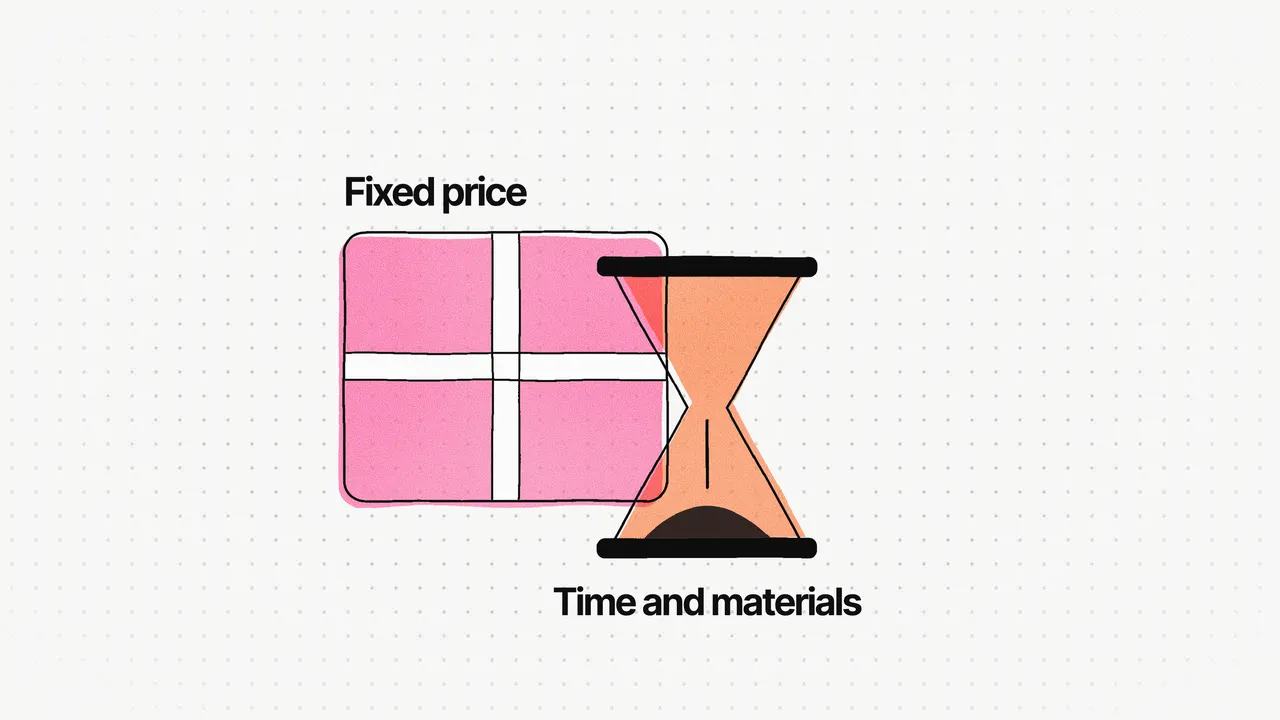

When founders ask me whether to pay a fixed price or time and materials for their MVP, my answer is: both, at different stages.
Pay a fixed price for discovery first. Then pay a fixed price for a first release whose scope is written down. After launch, when you're learning and changing things every week, switch to time and materials or a monthly retainer. Each way of paying fits the stage where its risk is easiest to manage.
Here's why, and what to put in place so each stage works.
How does each model shift the risk?
The real question behind "fixed or hourly" is who carries the risk that the work turns out bigger than expected.
| Question | Fixed price | Time and materials |
|---|---|---|
| Who carries scope risk | The development team | You |
| What the team does about it | Adds padding, and pushes back on changes | Bills the time the work actually takes |
| What you need for it to work | A written scope and a clear definition of done | Someone on your side who owns the scope every week |
| Where it goes wrong | A vague scope turns into a stream of change requests | Nobody says no, and the work keeps growing |
Neither model removes the risk. Fixed price moves it to the team, who price it in. Time and materials leaves it with you, so you need someone deciding what's in and what waits.
When does fixed price work?
When the scope is written down, the rules are known and the stretch of work is short enough to see the end of.
Discovery fits this perfectly. Its output is a set of documents and a prototype, so it's easy to define and easy to price. A first release fits too, once discovery has written its scope.
SmartPeople is the clearest example I have of holding a fixed plan. After a launch-readiness audit I ran, we committed to a 16-week plan to make the HR and payroll platform ready to launch. The date held because we cut about 30% of modules, features and reports from the launch instead of fixing everything halfway. A fixed scope sets the date more than team size does; I showed this across seven products in How long does it take to build an MVP?
Mark Andrews Creative shows the other half: a written scope makes a fixed date possible. The founder's brief was one sentence. I turned it into full requirements, specs and business logic, the developers built from that, and it went live in 12 weeks. How to scope an MVP shows how I write that kind of scope.
When does time and materials work?
When you can't write the scope yet, or when it changes every week.
After launch, that's normal. Users show you what's missing, and the best next change is often something nobody planned. On KpiClock, feedback after launch led to a change in how attendance works: starting the time tracker now marks attendance automatically. Work like that is hard to price in advance, because you only learn what's needed by shipping and watching.
Time and materials also works for a small team that already trusts each other, with someone on your side owning the scope. Without that person, hourly work tends to grow, because nobody is paid to say "that waits".
How do change requests work under a fixed price?
Changes will happen; the contract should make them cheap to handle. Three habits keep a fixed-price project moving:
- Write every change down. One short note: what changes, what it costs, how it moves the date. You approve it before anyone starts.
- Agree a small change budget upfront. A set amount of time or money for changes, so small ones don't need a negotiation each time.
- Swap instead of add. A new item replaces one of the same size that hasn't been built yet. The date and the price stay put.
Swapping is the one I use most. It forces the useful question: if this matters more, what matters less?
What should go in the contract?
I'm not a lawyer, and you should have one read any contract. From the product side, these are the parts I make sure exist:
- The scope document, attached, as the definition of what's being built.
- Acceptance: how you'll check each part is done, and how long you have to check it.
- The change process and the change budget.
- What's excluded, written out, so nobody assumes it's included.
- Launch support: how many weeks of fixes after launch are part of the price.
- Ownership of the code, designs and documents once they're paid for.
Why start with a fixed‑price discovery sprint?
Because it's the smallest commitment that makes every later decision easier. You pay a known amount and get a written scope, flows, a prototype, the rules and a build plan. Then you can ask for fixed-price build quotes that price the same product, or start on time and materials knowing what you're aiming for.
It also tells you, cheaply, whether you and the team work well together. What a discovery sprint should hand you lists the six things to expect from one, and Why MVP quotes range from $15k to $80k covers how to compare the build quotes that follow.
My MVP blueprint sprint is that kind of first step: a fixed scope and a set length, ending with the written first-release scope, flows, prototype, rules and build plan.
Frequently asked questions
Is fixed price or time and materials better for an MVP?
Neither on its own. Fixed price works for discovery and for a first release with a written scope. Time and materials works after launch, when the work changes week to week. Most MVPs are best served by fixed price first and time and materials later.
Why do fixed-price quotes cost more?
Because the team carries the risk that the scope is bigger than it looks, and prices that risk in. The clearer your written scope, the less they need to add.
How do change requests work in a fixed-price project?
Each change gets a short written note with its cost and its effect on the date, and you approve it before work starts. A small change budget agreed upfront, or a rule that a new item replaces one of the same size, keeps changes from stalling the project.
When should you switch to time and materials?
After the first release is live and you're changing the product based on what users do. At that point a fixed scope would be out of date within weeks, and paying for time lets you change direction without renegotiating.