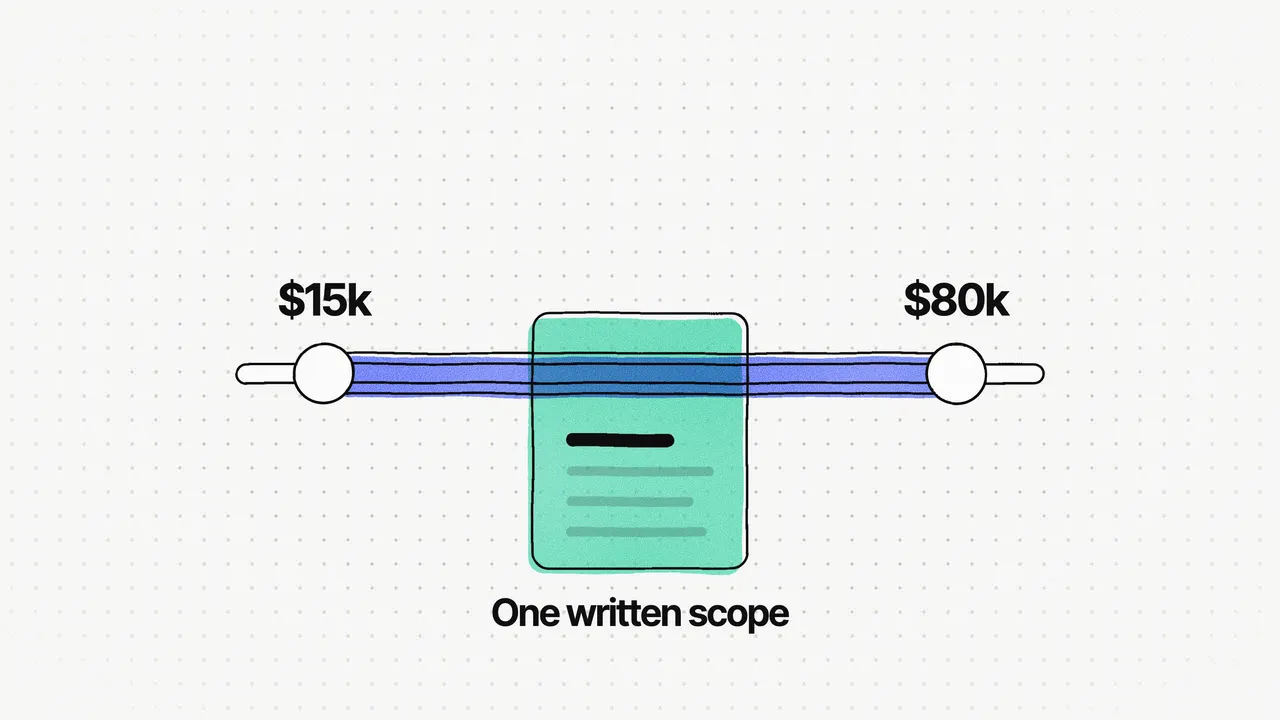

Founders often show me two or three quotes for their MVP and ask which one is right. For what sounds like the same product, the quotes they show me usually range from $15k to $80k.
The short answer: the gap comes from different scopes far more than from different hourly rates. Each team read your idea and quietly decided what the first release includes. Quotes only become comparable when every team prices the same written scope, with the same assumptions and the same definition of done.
Here's what moves the price, where the hidden costs sit, and how I'd make quotes comparable before choosing one.
What do MVP quotes usually look like?
The low ones are usually short: a list of screens, a total, a timeline. The high ones are longer and name things the low ones don't, like an admin area, reports, payment edge cases, testing and launch support.
That doesn't make the high quote right or the low one cheap. It means they priced different products. A quote is a team's guess at your scope, turned into money. When the guesses differ, so do the numbers.
What moves the price the most?
Five things, in my experience. Each one adds screens, rules and testing, and most of them add all three.
| What | Why it adds cost | An example from my work |
|---|---|---|
| Types of user | Each type needs its own screens, permissions and testing | AidNetwork launched four parts: a candidate web app, a candidate mobile app, an employer web app and an admin portal |
| Payments | Money needs exact rules for every case: failures, refunds, renewals | Mark Andrews Creative sells subscriptions, courses and physical goods through one checkout |
| Integrations | Each connection to another system needs building, testing and upkeep | SportsOnTV went the other way: integrating an existing stream, YouTube and a TV-listings widget made it faster to build |
| Admin tools | Someone has to run the product: orders, users, settings, reports | Mark Andrews Creative's platform has 20+ reports |
| AI | Prompts, a test set, structured output and a review step | LeanDeck's structured AI sections took more prompt and evaluation work than free text would have |
Integrations cut both ways. Connecting to a tool that already does the job is usually cheaper than building it. Connecting to five systems your product depends on is a cost of its own.
What costs are hidden in a low quote?
The ones that aren't on the list of screens:
- Discovery: deciding the scope, the rules and the order of work. If it isn't in the quote, it happens during the build, which is the most expensive place for it.
- Design: flows, screens, states and a clickable prototype. Some quotes assume you'll bring the design.
- Testing: every path, every device you care about, every payment case.
- Launch support: moving data across, fixing what real users find in the first weeks.
- Running costs: hosting, email, payments and any paid services, which you pay every month after launch.
None of these are padding. Each one gets done eventually, either inside the quote or as a surprise afterwards.
Does the timeline explain the price?
Partly, and it's a useful check. In the products I've led, the first launch or beta took between 5 and 16 weeks. SportsOnTV went live in 5 weeks, LeanDeck reached beta in 8, Mark Andrews Creative went live in 12, and SmartPeople ran to a fixed 16-week plan.
Scope decided the time more than the team did. The fast ones ran on existing tools or had a small, firm first release. The longer ones had money and rules that had to be right on day one. The full breakdown is in How long does it take to build an MVP?
So if two quotes promise the same date and differ by four times in price, ask what each one thinks the product is. If they promise very different dates, the answer is usually the same.
How do you make quotes comparable?
Give every team the same three things before they quote.
- One written scope. What's in the first release, and what waits until after launch. How to scope an MVP shows how I write one, and the PRD template gives you the structure for the rules behind it.
- The same assumptions. Who designs it, who hosts it, which integrations it uses, which devices it must work on, and whether data has to move across from an old system.
- The same definition of done. Tested on which devices, launched where, supported for how many weeks after launch.
Mark Andrews Creative started from a single sentence: a platform to sell courses, books and products, with e-learning like Coursera and Udemy. I wrote all the requirements, specs, feature definitions and business logic before the developers built from them. With that document, any two teams would have been quoting the same product.
What are the red flags in a quote?
- No questions asked. A team that quotes your idea without asking about users, payments or admin has guessed all three.
- No written scope. A total without a list of what's included can't be held to anything.
- A fixed price without discovery. It either has a lot of padding in it, or the hard questions will come back as change requests. I go through how each payment model shifts that risk in Fixed price or time and materials for an MVP?
A low quote is fine when it comes with a written scope and honest assumptions. A high quote is fine when you can see what you're paying for. What isn't fine is a number with nothing behind it.
Where should the first money go?
Into a paid blueprint before any build quote: a written scope, user flows, a clickable prototype of the key screens, the rules developers build from, and a build plan with a timeline and a budget range.
It costs a fraction of the build, and it turns every quote you get afterwards into a comparison of the same thing. It also gives you something you own, whichever team builds it.
That blueprint is what my MVP blueprint sprint produces: a fixed-scope sprint that ends with the scope, flows, prototype, rules and build plan, so the quotes you get afterwards price the same product.
Frequently asked questions
How much does an MVP cost?
The quotes founders show me usually range from $15k to $80k. Where yours lands depends on how many types of user it serves, whether money moves through it, how many other systems it connects to, how much admin it needs, and whether it uses AI.
Why are MVP quotes so different for the same idea?
Because each team has guessed a different scope. One prices a single user type and a simple checkout; another prices three user types, subscriptions, reports and integrations. Until the scope is written down, you're comparing guesses.
How do you compare quotes from different development teams?
Give every team the same written scope, the same assumptions about design, hosting and integrations, and the same definition of done. Then compare what each one includes, what it leaves out and how it handles changes.
What are red flags in an MVP quote?
A team that asks no questions, a quote with no written scope behind it, and a fixed price given without any discovery. Each one means the real scope will be decided later, usually at your cost.