Pricing is a product decision. It decides who signs up, who stays, and whether your revenue grows when your customers do. I've designed pricing models for products I've led, and I start each one with the same question: what grows when the customer gets more value?
This post explains the main SaaS pricing models in plain words: what each charges for, who it suits, and where it backfires. There are no prices in it. The examples are real models from products I've worked on.
What are the main SaaS pricing models?
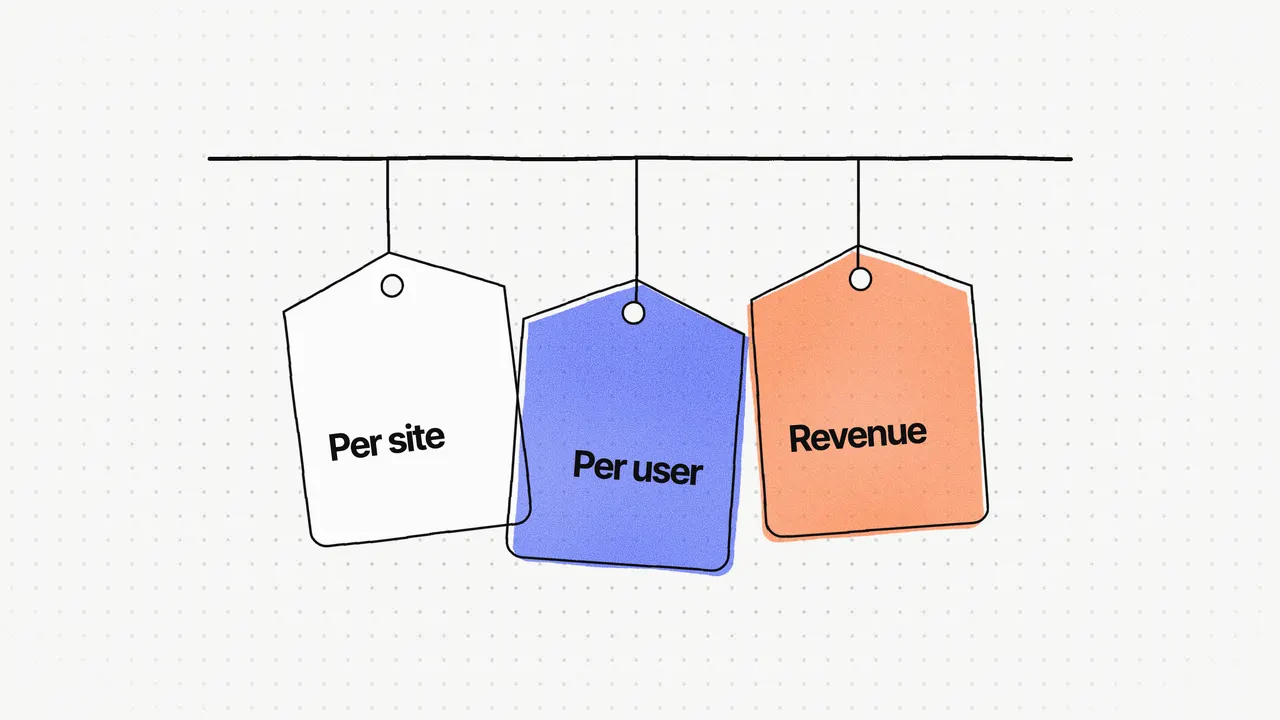
Most SaaS pricing is one of these, or a mix:
- Per user (often called per seat): a price for each person who uses the product.
- Per user, with users included: a plan includes a set number of users, and extra users cost more.
- Per location: a price for each site, branch or venue.
- Usage-based: a price for what's consumed, such as documents, minutes or downloads.
- Revenue-based: a price that follows the revenue the customer runs through the product.
- Free tier plus paid product: a free entry point, with the full product paid for.
They aren't exclusive. A plan can be per user and have usage limits, or start free and become revenue-based.
Which model charges for what?
| Model | Charges for | Good for | Watch out for | Real example |
|---|---|---|---|---|
| Per user | Each person using the product | Tools everyone on a team uses daily | Buyers compare it line by line with other tools | KpiClock: per user, in two tiers |
| Per user, users included | A plan with a set number of users; extras billed | Teams of very different sizes | More complexity in invitations, access rights and invoices | Mark Andrews Creative: 5 users included, extra users billed per the tier's conditions |
| Per location | Each site or branch | Businesses whose sites are much alike | It can make growing into new sites feel costly | Find Your Calm chose against it: locations don't change the price |
| Usage-based | What's consumed | Products where use varies a lot between customers | Bills that are hard to predict | Mark Andrews Creative caps downloads per month inside each tier (a limit, without usage billing) |
| Revenue-based | The revenue a customer manages through the product | Booking and commerce products that carry the customer's revenue | It needs revenue data both sides trust | Find Your Calm: booking software priced by revenue managed |
| Free tier plus paid | Nothing to start; the full product is paid | Marketplaces that need supply before they earn | The business grows before it earns | Find Your Calm: a free marketplace listing |
No project of mine bills by usage or by location, so those two rows show the nearest real decision instead.
When does per‑user pricing work, and when does it backfire?
It works when everyone on a team uses the product and value grows with the team. KpiClock is a team management product: time tracking, HR and e-signature in one, in place of Hubstaff, BambooHR and DocuSign. Everyone on the team uses it, so per-user pricing in two tiers made sense. We said no to per-module pricing, so the value of having everything in one product shows in one number.
The trade-off is that per-user pricing invites comparison: buyers line it up against three separate subscriptions. KpiClock's marketing site answers that with an interactive cost comparison tool.
Varsee, an AI live-shopping product, is planned the same way: per-user SaaS in three tiers, so the cost grows with the store's sales team and traffic doesn't change it.
Where per user backfires, in my view, is when one person does the work for many, or when the product's value doesn't depend on how many people log in. A booking platform is a good example.
Why price a booking platform by revenue?
Find Your Calm is a booking platform and marketplace for wellness operators. I designed its pricing model, and the client approved it. It has two tiers: a free marketplace listing, and paid booking software priced by the revenue each operator manages. The number of users and locations doesn't change the price.
There's no commission on transactions, because operators take payments through their own payment accounts. That means the platform earns from operator success: when an operator's revenue grows, so does what they pay. The free listing brings new operators in, so the marketplace grows before it earns.
The cost is patience. A free tier and no commission mean revenue follows growth, and doesn't arrive first. The full reasoning is in Why we priced Find Your Calm by the revenue operators manage.
Where do limits fit in?
Limits shape behaviour without changing the model. Mark Andrews Creative sells a subscription library in tiers, monthly or yearly. Each tier has monthly download limits on courses and modules, and downloads stay with the subscriber. Each subscription includes 5 users at a fixed price, and extra users are billed per the tier's conditions.
That gave the business predictable revenue, a reason to stay subscribed every month, and pricing that grows with each team. It cost something too: limits can feel restrictive to heavy users, and billing per user added complexity to invitations, access rights and invoices. I go through the platform side in How to build an e-learning platform like Udemy.
How do you pick a pricing model?
These are the questions I work through, in order.
- What grows when the customer gets more value? Revenue for a booking platform, team size for a team tool, use for a heavy-consumption product.
- Can both sides see that number and trust it? Revenue-based pricing only works if revenue data is clear to both.
- What will buyers compare you with? If you replace several tools, make the comparison easy and in your favour.
- What do you need first: revenue or growth? A free tier grows a marketplace; it doesn't fund it on day one.
- What limits keep the product sustainable? Download limits, included users, and similar caps protect the business without changing the model.
Frequently asked questions
What is the difference between per-user and usage-based pricing?
Per-user pricing (often called per seat) charges for each person who uses the product, whatever they do with it. Usage-based pricing charges for what's consumed, whoever consumes it. Per user is easier to predict; usage follows value more closely but makes bills harder to forecast.
What is revenue-based pricing in SaaS?
The price follows the revenue a customer manages through the product. Find Your Calm prices its booking software that way: the number of users and locations doesn't change the price, and there's no commission on transactions, because operators take payments through their own payment accounts.
Which SaaS pricing model is best?
The one that grows when your customer gets more value from the product. For a booking platform that's the revenue an operator manages; for a team tool used by everyone, it's often the number of users.
Should a SaaS product charge per module?
It can, but I'd be careful when the product replaces several tools. KpiClock said no to per-module pricing and kept simple per-user pricing in two tiers, so the value of having everything in one product shows in one number.