
Many founders I talk to know their AI product's price before they know what one task costs them. That's risky, because an AI feature costs you money every time someone uses it.
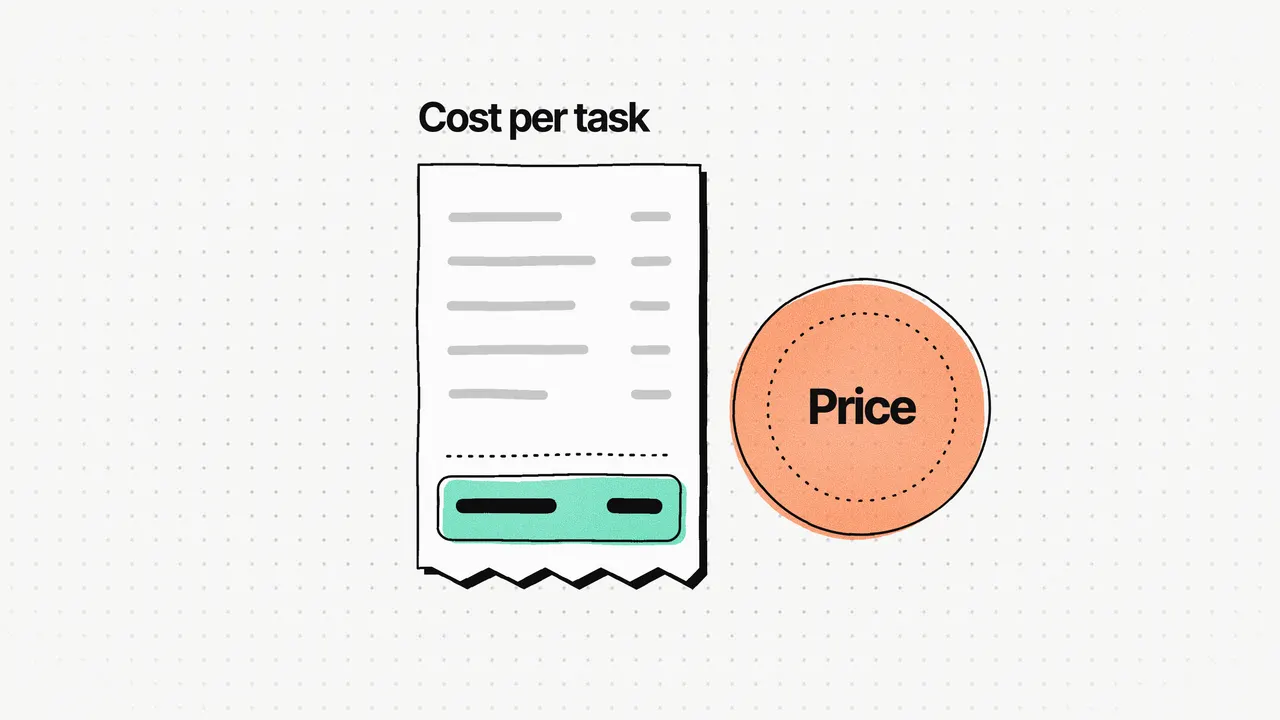
The number to know is the cost per task: what one finished piece of work costs you in model fees, retries, review time and storage. Once you have it, check that your price per user covers your heaviest realistic user, around the 90th percentile, with margin left over. If it doesn't, change the limits or the price before launch, while it's still easy.
Here's how I work it out, with a worked example.
What goes into the cost of one AI task?
Four things, and the first one is the only one most people count.
- Input and output tokens. Providers charge per token (a small piece of a word), with separate prices for what you send and what the model writes back. Output usually costs several times more per token than input.
- Retries and longer inputs. Some tasks get re-run because the first answer wasn't right, and some users paste in much longer material than you planned for. Both multiply the model fee.
- Human review time. If your own team checks the output before a customer sees it, those minutes are part of the cost. Time spent by the customer reviewing their own draft isn't your cost, but it is part of the value.
- Storage. Inputs, outputs and the history of edits you keep. Usually small, but it never goes away.
What's the formula, with real numbers?
The formula I use:
cost per task = (input tokens × input price + output tokens × output price) × (1 + retry rate) + review minutes × cost per minute + storage per task
Here's a worked example. Everything in it is an example, except the model prices, which are Claude Sonnet 5.5's list prices from Anthropic's official pricing page, checked on 15 November 2026: $2 per million input tokens and $10 per million output tokens. Prices change, so check the page on the day you do this.
The example task: an AI drafts a two-page document from a customer's brief. Each run sends 6,000 tokens (your instructions, a few examples and the brief) and gets 2,000 tokens back. One in four drafts gets regenerated once.
| Line | Working | Cost |
|---|---|---|
| Input | 6,000 × $2 / 1,000,000 | $0.012 |
| Output | 2,000 × $10 / 1,000,000 | $0.020 |
| One run | $0.012 + $0.020 | $0.032 |
| With retries | $0.032 × 1.25 | $0.040 |
| Storage | an assumed figure for this example | $0.001 |
| Cost per task | $0.040 + $0.001 | $0.041 |
| If your team reviews it for 2 minutes at $30 an hour | $0.041 + $1.00 | $1.041 |
Two things stand out. The model fee is tiny for one task. And if your own staff review every output, their time costs about 24 times more than the model in this example. Review is often the right call at launch, but plan for it to shrink.
That's how it went on SportsOnTV. AI sports summaries went to a review panel first, and at launch the client's own team reviewed and published each one. After we tuned the AI on their feedback, they told us they no longer needed to check each summary.
Why price for your heaviest users?
Because AI costs grow with use, and averages hide the people who use your product most.
Continue the example. An average user runs 40 tasks a month: 40 × $0.041 = $1.64. A user at the 90th percentile runs 300: 300 × $0.041 = $12.30. Now suppose that heavy user also pastes in long documents, so each run sends 40,000 tokens instead of 6,000. One run now costs $0.08 + $0.02 = $0.10, $0.125 with retries, about $0.126 with storage, and 300 of them cost $37.80 a month.
If your example price is $29 per user per month, the average user leaves plenty of margin and the heavy user costs you more than they pay. You won't see it in your averages until those users are your biggest accounts.
How should the cost shape your pricing?
Three common shapes, each with a different answer to heavy users:
- A price per user, simple to buy and simple to sell. It works when your heaviest realistic user still leaves margin.
- Usage limits per plan, such as a number of tasks included each month. Mark Andrews Creative's subscription tiers use monthly download limits for a similar reason: they keep the content library sustainable and make revenue predictable.
- Credits, where customers buy tasks in packs. Fair for very uneven use, harder to explain.
Whichever shape you choose, price from the value first. In LeanDeck, a proposal or agreement takes about 5 minutes, against 6 to 10 hours by hand. That saving is what customers pay for, and it sets the ceiling; the cost per task sets the floor. On Find Your Calm I priced the booking software by the revenue each operator manages, which keeps the price in step with what the product is worth to them. The reasoning is in Why we priced Find Your Calm by the revenue operators manage, and the wider options are in SaaS pricing models explained.
Keep money-moving parts on fixed rules too. LeanDeck runs on GPT-5.1 for drafting, and its invoicing follows fixed rules: the amounts come from the priced scope. A wrong invoice is expensive in trust, and a rule costs nothing per run in model fees.
When should you cut the cost, and how?
Once you know the cost per task and it's too close to your price. Not before: early on, a better answer is worth more than a cheaper one.
The levers I use, roughly in order:
- A smaller model for the easy steps. Sorting, extracting and routing rarely need the biggest model. Providers' pricing pages list smaller models at a fraction of the price.
- Shorter prompts. Instructions grow over time. Cut what the test set shows doesn't change the result.
- Caching. If every task sends the same long instructions, many providers charge much less for input they've already seen. Anthropic's pricing page lists cached input at a small fraction of the normal input price.
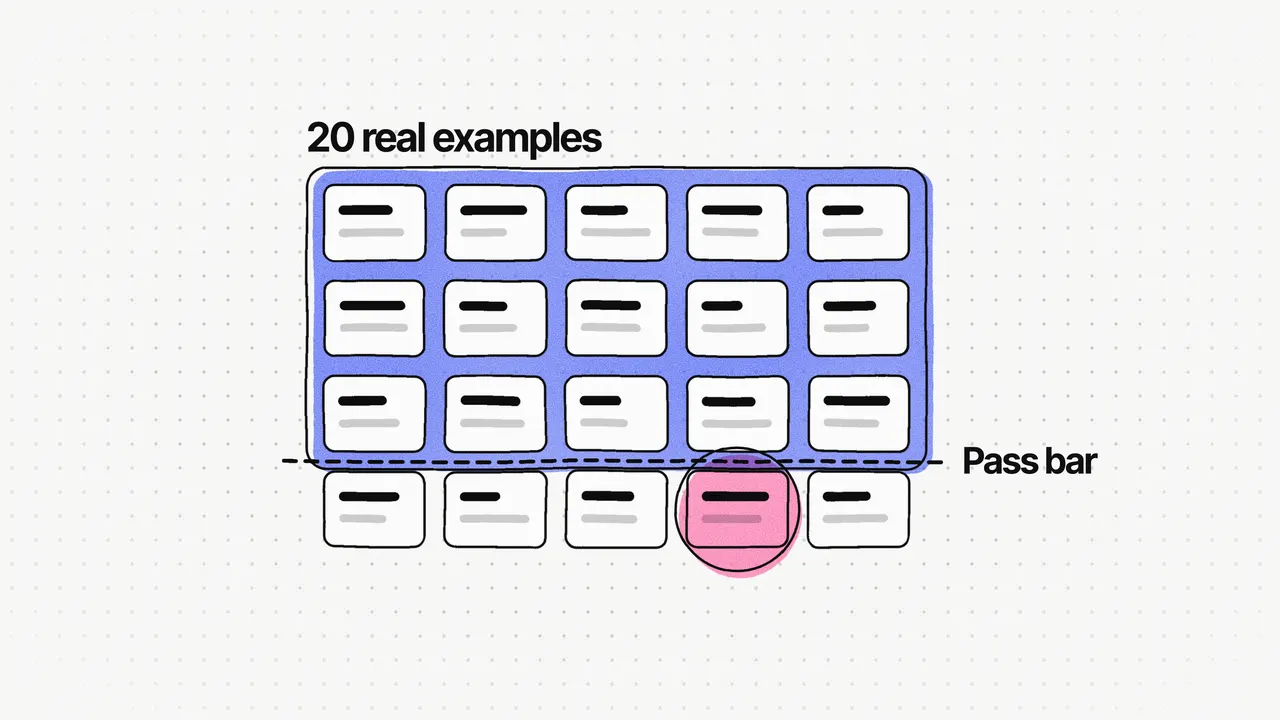
- Fewer retries. Better structure and better examples mean fewer re-runs. This is where a fixed test set pays off; I explain how I build one in Test your AI feature with 20 real examples.
Working out the cost per AI task is part of my AI MVP blueprint sprint, alongside where the AI acts, the test set and the review step, so the price you launch with is one you can keep.
Frequently asked questions
How do you calculate the cost of an AI feature?
Multiply the input tokens by the input price and the output tokens by the output price, add the share of tasks that get re-run, then add any time your own team spends reviewing and the storage each task uses. That's your cost per finished task.
How should you price an AI feature?
Start from the value of the task to the customer, then check the cost side. Your price per user has to cover your heaviest realistic user with margin. If it can't, add usage limits or credits instead of raising the price for everyone.
Why does the 90th-percentile user matter more than the average user?
Because AI costs grow with use, and a small group of heavy users can cost several times more than the average. If your price only covers the average, those users turn your best customers into your least profitable ones.
How can you lower the cost of an AI feature?
Use a smaller model for easy steps, shorten the prompt, reuse cached input where your provider supports it, and keep anything that can follow fixed rules out of the model entirely.